
Over the last week AI has basically all been Jev.
Jev is the first “System One” model from TypeSafe AI, released Sept. 15. The name borrows from Daniel Kahneman’s Thinking, Fast and Slow.
Think of System 1 as the quick gut-level call. System 2 is more slow deliberate thinking. Most of what we call AI today (at least referring to LLMs) is built for System 2 that reason, write, and explain one token at a time.
Jev is built for the other half. You can hand it the state of a system and a set of typed questions and it will hand back a choice from the options you defined with a probability attached.
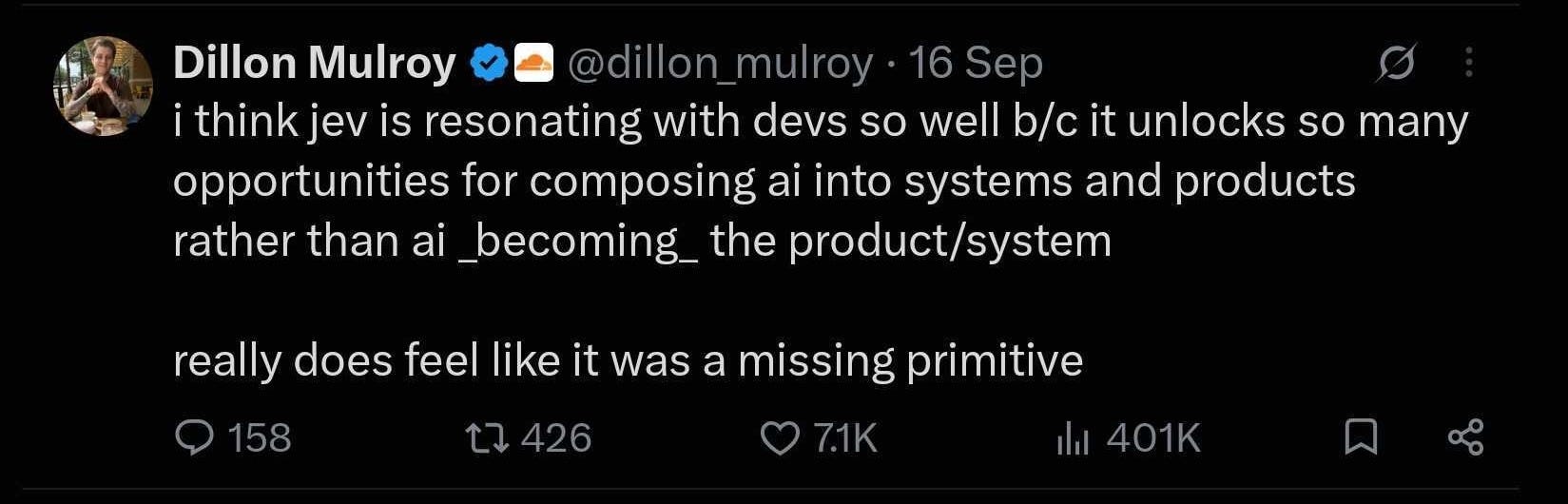
I posted a link on our internal Slack channel just after release and asked the team for initial tests. Results were very interesting… In this article I’ll cover why I care, and why I think anyone building AI for production should too.
Most AI work is decisions
Open up any production agent and count the calls it makes to a model. A huge percentage of these calls are small decisions dressed up as text generation:
Should this question go to agentic search/RAG
Which queue does this support ticket belong in?
Did the agent’s answer pass or fail?
Which category in one system matches this line item from another?
Today most teams send each of those through a frontier LLM. We write a prompt parse the output, and handle the times it comes back malformed. We pay for output tokens we throw away, which is fine when you prototype, but expensive at scale. We also wait seconds for an answer that is ultimately a binary yes or no.
Tomasz Tunguz put it well “AI is coming for the if statement”. He replaced roughly 25% of the model calls in one of his agents with specialized deciders, and on 98 verified email threads the decider was right 80% of the time against 47% for a generative model.
What the Numbers Say
TypeSafe reports responses in 70 to 500 milliseconds, input priced at US$0.042 per million tokens, and free output tokens. The headline claim is up to 193 times faster and 444 times cheaper than frontier LLMs. Impressive, but those are vendor numbers from vendor-chosen tests.
The more useful early evidence comes from outside. LangChain tested Jev as an evaluator for agent outputs in LangSmith. On a pass/fail judgment, Jev matched human reviewers 100% of the time, compared with 80% for Claude. Its scores barely moved across 100 repeat runs. The full test cost 34 cents with Jev and $28.17 with Claude.
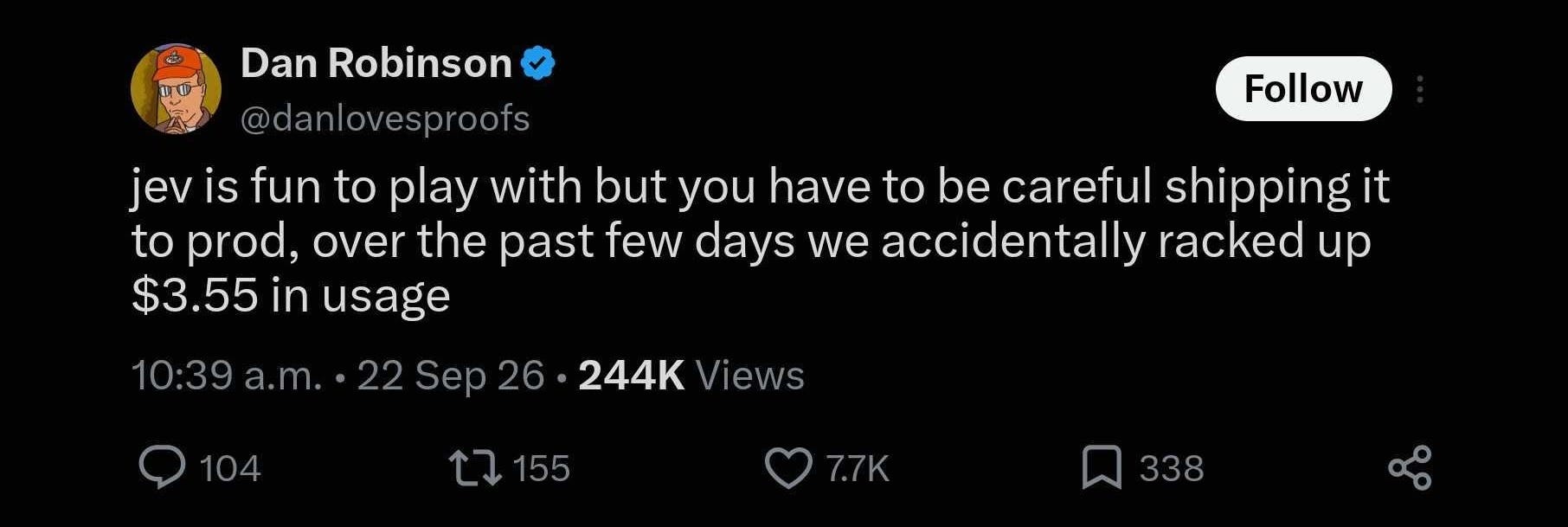
That’s five test cases on one weather agent, far too small to settle anything for our clients’ workflows, but enough to justify a real experiment.
The limits are real too. Developer Flavio Copes, who mapped them in detail, points out that Jev always returns one of the options you define, so you need an “other” choice for inputs that don’t fit. It doesn’t count reliably, struggles with dates and double negatives, reads text only, and caps out at 255 choices per question. It also can’t write, so anything a person needs to read still needs a generative model.
Why This Matters to those Building in the Applicaiton Layer
We built AltaML in the classical ML world. In the “old days” before LLMs, a lot of our work was classification. Is this pump about to fail? Is this claim likely fraudulent? Which customers are about to leave? Which of 40 categories does this document belong in? We trained a model, measured it against labeled data, and put it into production with a confidence threshold.
Jev looks a lot like that discipline delivered as an API. That’s why I think teams with ML roots are better placed to use it well than teams that started with ChatGPT. The skills that matter here are ones our people have used for a decade. Start with defining a clean label set (which rarely exists), build ground-truth data (often massive human involvement), calibrate the right threshold (huge debate with SMEs), and then figure out the adoption issue, especially when a supposedly confident answer is still wrong.
Our team has already flagged where they want to test first:
Routing inside agents. Deciding which retrieval path, tool, or model a request needs, and do it in milliseconds instead of seconds.
Evals. Many of our LLM-as-judge prompts already return true or false. When we don’t need the reasoning, a typed score is cheaper and repeatable.
Mapping between systems of record. For example, invoices that categorize items differently than the ERP, time sheets that don’t line up with billing codes, freeform text that never matches exactly, etc.
Checks before an agent acts. A fast gate that asks whether a proposed action fits policy before it runs.
Cost changes what’s worth building. When a decision costs a fraction of a cent, scoring every agent trace in production is no longer a budget conversation. Neither is classifying the millions of records a client has sitting in an old system.
It also fits where we’re taking our business. We’re moving clients toward pricing tied to outcomes. When the cost of each decision drops this far, that margin can go back to the client as a lower price or into more quality checks. The client comes out ahead either way.
How We’re Testing It
Here’s the approach we are trying:
Pick a live decision point where we already have labeled data and a current baseline.
Run Jev beside the existing LLM call and compare accuracy, speed, and cost on the same inputs.
Always include an “other” or “none of these” option, and track how often it gets picked.
Keep a human reviewing a sample. A cheap evaluator that is consistently wrong makes bad calls at scale.
Decide on our data. If it doesn’t beat the baseline, it doesn’t ship.
The Bigger Picture
I expect production AI to split in two. Frontier models will handle the open-ended work of reasoning and writing. Fast, cheap deciders will handle the thousands of small calls that run a workflow every day. The companies that get this right will know which is which at every step.
We’ll share what we find. If you’ve already put Jev against a real workload, I’d love to hear how it went. What broke? What are we missing?
Sources
TypeSafe AI. “Introducing System One Models and Jev.” TypeSafe AI Blog. Sept. 15, 2026.
LangChain. “Jev as an Agent Evaluator in LangSmith.” LangChain Blog. 2026.
Tunguz, Tomasz. “AI Comes for the If Statement.” Tomasz Tunguz. 2026.
Copes, Flavio. “A Deep Dive into Jev, TypeSafe’s System One Model.” Flavio Copes. Sept. 24, 2026.